Build AI alone
We have now covered the full physical stack — from the chip to the magnet to the mine. Every layer is more globally interconnected, and more fragile in specific ways, than the surface narrative about AI as a software industry suggests.
Given all this interdependence, can any single country or group of countries actually achieve self-sufficient AI capability? And what happens when they try — and start actively blocking each other from doing the same?
The AI supply chain is globally integrated by decades of comparative advantage, deliberate specialisation, and historical accident. Closing the loop within a single national boundary would require rebuilding capabilities that the rest of the world spent sixty years developing. What makes the situation genuinely interesting is that each major player is missing completely different pieces.
The US position #
The United States controls the highest-value layers of the stack. Foundation model development. GPU architecture. Cloud infrastructure. The EDA software that makes chip design possible. Semiconductor equipment represents the concentrated output of generations of engineering talent, enormous private investment, and a set of software ecosystems that are very hard to dislodge.
What the US controls:
- Foundation model development (OpenAI, Anthropic, Google DeepMind, Meta AI, xAI)
- GPU and accelerator design (NVIDIA, AMD, Intel, plus hyperscaler custom silicon)
- Cloud infrastructure at scale (AWS, Azure, Google Cloud)
- EDA software — effectively the global standard (Synopsys, Cadence)
- Core semiconductor process equipment (Applied Materials, Lam Research, KLA)
- Some memory production (Micron)
What the US depends on others for:
- Leading-edge chip fabrication → TSMC (Taiwan)
- EUV lithography machines → ASML (Netherlands)
- EUV optics → ZEISS SMT (Germany)
- EUV laser systems → TRUMPF (Germany)
- High-bandwidth memory → SK hynix, Samsung (South Korea)
- Advanced wafers, photoresists and specialty materials → Shin-Etsu, SUMCO, JSR (Japan)
- Rare-earth permanent magnet production → China
- Nuclear fuel enrichment services → Russia supplied 20% of enrichment services to US reactors as recently as 2024[1]
The fabrication dependency on Taiwan is the one that generates the most political attention, and reasonably so. TSMC makes the leading-edge logic dies inside virtually every GPU, custom AI accelerator and advanced processor used in the US. The CHIPS and Science Act was a multi-billion dollar attempt to partially close that gap. But even with TSMC Arizona fabs online, the US is years away from meaningful fabrication independence — and TSMC itself still depends on ASML for its most advanced tools.
The US is the largest single contributor to the AI stack. But it is not self-sufficient.
The China position #
China's situation is roughly the inverse of the US position. It controls the industrial foundation — materials, processing, manufacturing at scale — but is blocked, by export controls and by the physics of what it can currently build, at the leading edge of the fabrication layer.
What China controls:
- The world's dominant share of rare-earth separation, refining and permanent-magnet manufacturing
- Significant gallium and germanium production — and the willingness to use export controls on both
- A substantial domestic chip design ecosystem (Huawei HiSilicon, Cambricon, Biren, Moore Threads)
- Mature-node chip fabrication (SMIC and others, operating at 7nm and older processes)
- The largest domestic AI deployment market on the planet
- Significant AI training infrastructure (Alibaba, Baidu, Tencent, Huawei)
What China cannot currently do:
- Manufacture leading-edge logic chips at sub-5nm — blocked from EUV machines by export controls
- Produce high-bandwidth memory at the density and yield of SK hynix or Samsung
- Access the full EDA software stack under current US export restrictions
- Match TSMC's advanced packaging capability at scale
The EUV wall is the hard constraint. Without access to ASML machines — which the Netherlands restricts under US diplomatic pressure — Chinese foundries cannot print transistors at the geometries required for the most powerful AI accelerators. SMIC has extracted impressive results from older DUV equipment, but there are physical limits to that approach that will not be engineered away.
China's strategic response has been consistent: invest heavily in the layers it can control, accept the leading-edge chip gap as a medium-term constraint, and pursue alternatives with an urgency and funding level that most Western observers underestimate. The goal is to find enough alternative paths — in chip architectures, materials leverage, and deployment scale — to be viable regardless.
The European position #
Europe's situation is the strangest of the three. It controls some of the most irreplaceable components in the entire global AI stack — and has almost nothing else.
ASML makes the only EUV lithography machine on the planet. ZEISS SMT makes the ultra-precision mirrors inside it. TRUMPF makes the laser system that generates EUV light. Remove those three Dutch and German companies and the leading edge of semiconductor manufacturing stops. Not slows. Stops.
But Europe has no leading AI model provider at scale. No leading-edge foundry. No GPU or accelerator platform with global market share. No hyperscaler. The continent that makes the indispensable tools for building AI chips is not, itself, building competitive AI systems.
This creates a peculiar strategic position: significant leverage over the global supply chain, combined with significant dependence on American software and Asian fabrication for actually running anything. The leverage is exercised primarily under US diplomatic direction — the ASML export restrictions on China came after sustained US pressure on the Dutch government.
Whether Europe's chokepoint assets translate into strategic autonomy depends on whether Europe chooses to use them independently. That is a political question the continent has not yet answered.
The capability map #
Here is where each major bloc's strengths and gaps actually sit:
| Capability | US | China | Europe | Japan | South Korea | Taiwan |
|---|---|---|---|---|---|---|
| Foundation model development | ✓✓ | ✓ | — | — | — | — |
| GPU / accelerator design | ✓✓ | ✓ | — | — | — | — |
| Cloud infrastructure | ✓✓ | ✓ | part | — | — | — |
| EDA software | ✓✓ | part | ✓ (Siemens) | — | — | — |
| EUV lithography | — | — | ✓✓ (ASML) | — | — | — |
| EUV optics and lasers | — | — | ✓✓ (ZEISS, TRUMPF) | — | — | — |
| Semiconductor process equipment | ✓✓ | part | — | ✓ (TEL) | — | — |
| Leading-edge chip fabrication | — | — | — | — | ✓ (Samsung) | ✓✓ (TSMC) |
| High-bandwidth memory | ✓ (Micron) | — | — | — | ✓✓ (SK hynix, Samsung) | — |
| Wafers and specialty materials | — | — | ✓ (Wacker, Siltronic) | ✓✓ | — | ✓ (GlobalWafers) |
| Rare-earth magnets | — | ✓✓ | — | ✓ (partial) | — | — |
| Critical minerals processing | part | ✓✓ | — | — | — | — |
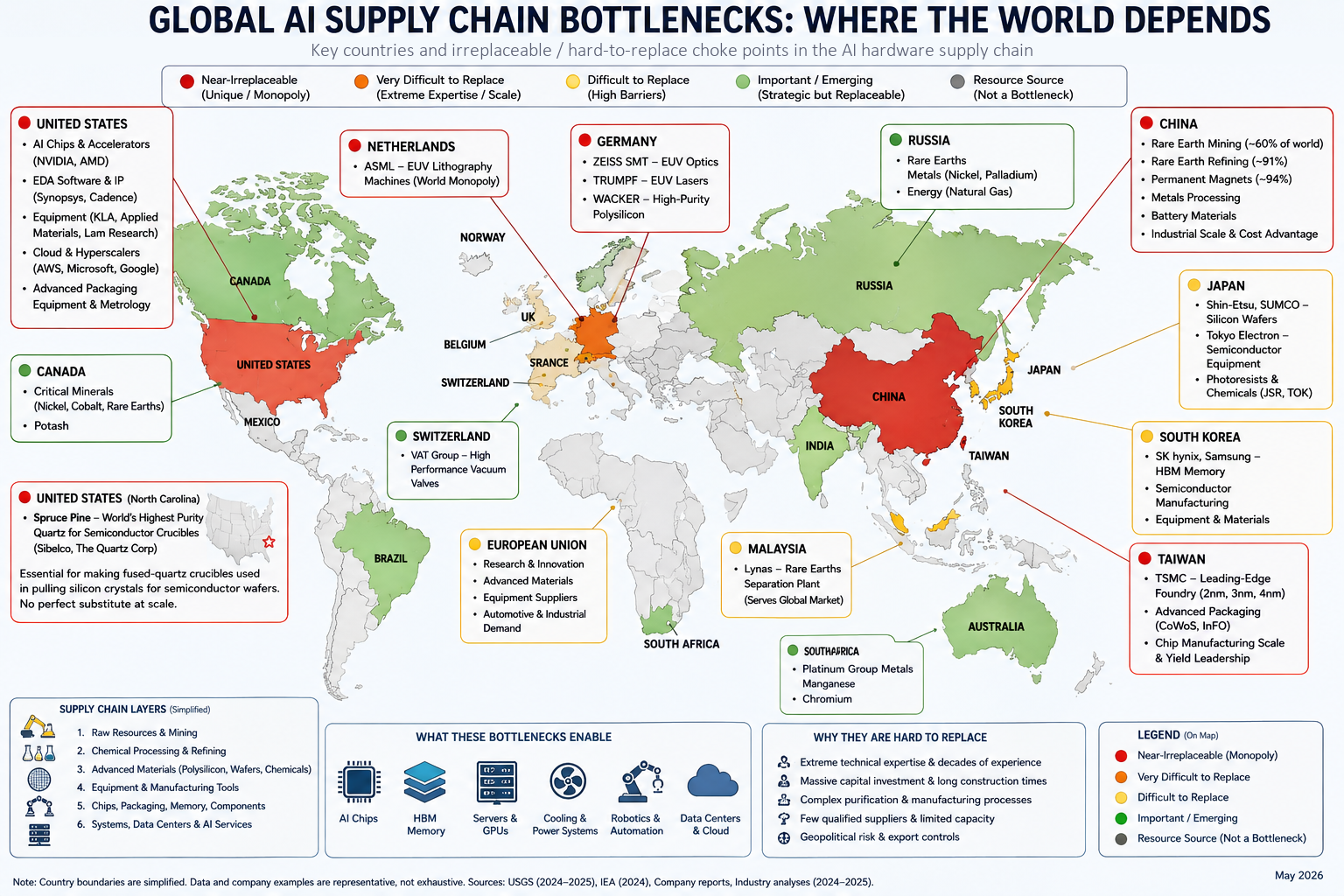
Each major player controls something essential and depends on others for something equally essential.
Closing the loop #
If any country or bloc genuinely wanted to build and run leading-edge AI without depending on a potentially hostile nation, here is the complete list of what it would need to control:
Foundation model design and training infrastructure
              +
AI accelerator chip design
              +
Leading-edge chip fabrication (currently sub-5nm)
              +
Advanced packaging (CoWoS-scale integration)
              +
High-bandwidth memory design and volume production
              +
EUV lithography systems and optics
              +
Full semiconductor process equipment stack
              +
Specialty wafers, photoresists and process chemicals
              +
Rare-earth permanent magnet production
              +
Data centre power and cooling infrastructure
              +
Stable, domestically controlled electricity generation
              +
Network infrastructure and connectivity
Every item on that list represents years to decades of industrial development. The US has a meaningful position in most of those categories. It still depends critically on Taiwan, the Netherlands, Germany and Japan for the ones it lacks.
No other country gets past the first third of the list without significant gaps.
Dependency flip side #
The flip side of dependency is leverage. Every chokepoint is both a vulnerability for the buyer and a potential advantage for the seller — if the seller is willing to use it.
Export controls have become the primary instrument of AI geopolitics precisely because the supply chain is so integrated. The US restricts NVIDIA's most advanced chips from reaching China. The Netherlands restricts ASML's EUV machines. Japan restricts specific semiconductor chemicals and equipment. China restricts gallium, germanium and rare-earth exports. Each restriction targets a chokepoint identified in a dependency map not unlike the one above.
What makes this genuinely dangerous is that the chokepoints are not symmetric.
A restriction on EUV machines — held by a single Dutch company — can affect the entire global leading-edge semiconductor industry. A restriction on rare-earth separation capacity — where China holds dominant share — can constrain motor, magnet and cooling equipment production worldwide. A restriction on nuclear enrichment services, where Russia has provided a significant share of Western reactor fuel, runs through the electricity supply that powers the data centres that run the models.
The dependencies are global. The controls are national. The asymmetry gives disproportionate leverage to countries with narrow but irreplaceable capabilities — regardless of their overall economic or military size.
The structural reality #
No country is going to close the loop in the foreseeable future. Strategic risk is different for every country.
For the US, the Taiwan fabrication dependency is the most discussed concern because of geography and the possibility of conflict. For China, the EUV access gap is the hard ceiling on leading-edge production. For Europe, the dependence on US software and Asian fabrication is significant and largely under-discussed.
What every country shares is this: the AI stack was built globally because global specialisation produces better components at lower cost. Treating it as something that can be fully nationalised — without losing the decades of accumulated expertise that made each node world-class could be a mistake.
The more realistic path is managed interdependence: understanding exactly which dependencies you carry, knowing which ones you could survive losing, and having a credible plan for the ones you could not. Most countries are not yet at that level of clarity.